
April 2022

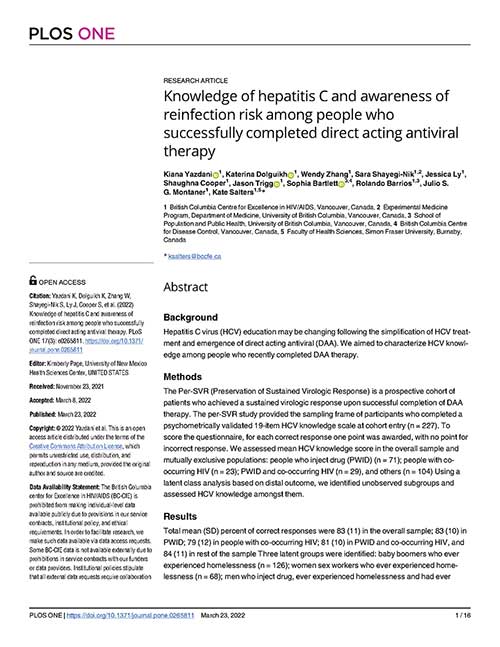
BC-CfE researchers examine HCV knowledge and awareness of reinfection risk among people successfully treated with direct acting antiviral therapy

The Hepatitis C virus (HCV) is a blood borne infection and a leading cause of end-stage liver disease. The World Health Organization estimates that about 58 million people are living with chronic HCV, leading to 290,000 deaths annually due to HCV-related liver illness. Here in Canada, HCV affects a quarter of a million people. Of this quarter million, over 40% are unaware of their infection.

BC-CfE researchers examine HCV knowledge and awareness of reinfection risk among people successfully treated with direct acting antiviral therapy Read More »

BC-CfE study examines how neighbourhood poverty affects those living with HIV

A recently published study by BC-CfE researchers titled Neighbourhood-level material deprivation and response to combination antiretroviral therapy in the Canadian Observational Cohort (CANOC): a longitudinal cohort studyexamines the relationship between a neighbourhood’s socioeconomic status and how this affects the lives and health of Canadians living with HIV who are on combination antiretroviral therapy (ART).

BC-CfE study examines how neighbourhood poverty affects those living with HIV Read More »

Scroll to Top

The BC-CfE Laboratory is streamlining reporting processes for certain tests in order to simplify distribution and record-keeping, and to ensure completeness of results. Beginning September 2, 2025, results for the ‘Resistance Analysis of HIV-1 Protease and Reverse Transcriptase’ (Protease-RT) and ‘HIV-1 Integrase Resistance Genotype’ tests will be combined into a single ‘HIV-1 Resistance Genotype Report’.
For more details and example reports, please click on the button below